index button

About OVMRO | Media Coverage | Treble Three | Contact Us | Oggie 8 Challenge Tributes

incidents button

Incidents | Maps | Summary | Graphs

training button

Membership | Log Book | Team Events| Photos of Training Events

resources button

Weather | Webcam |  Useful DocumentsPictures of Ogwen |  Wish list

reports button

Annual Reports |  Latest Year

miscellaneous button

Lost & Found |  MREW |  NWMRA |  SAR Links | UK-SAR

shim button
Ogwen Valley Mountain Rescue Organisation
Mountain Rescue England & Wales
Ogwen Valley Mountain Rescue Organisation
OVMRO is a registered charity (No. 502442)
Click here to donate on-line

Latest News

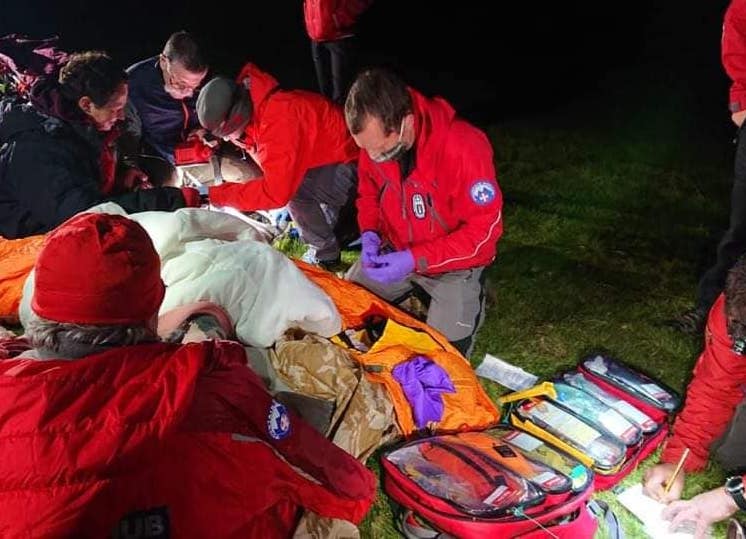
Casualty Care

DSCF5682.JPG

Skills require appropriate training which places an increasingly high time demand upon members. It is therefore not surprising that over the last 18 months the number of members progressing the full casualty care pathway has reduced.

Levels of training

It remains a requirement for all full Team members to obtain the one day in-house training covering Basic Life Support techniques and fundamental aspects of mountain rescue first aid. This programme includes the use of AED (Automated External Defibrillator) and CPR (Cardio Pulmonary Resuscitation). Many members retain the ECMR (Emergency Care for Mountain Rescue) Intermediate Level / MRC ‘qualification’. The adherence to the MRC curriculum and later success in standardised theory and practical assessments, (assessed by external medical doctors), is a requirement to practice casualty care under the cover of the MRC Insurance.

Six Team members work at the ECMR Advanced Level, which also incorporates the MRC syllabus and assessments. The total number of higher trained members is approximately 30% of the operational membership. The aspirational target is 50%.

Equipment review

Over the last twelve months there has been no major change in the type of equipment held. The Sam Pelvic Splint has gained increased recognition for its ease of use and appropriate pressure application. Its weight and compact design makes it compulsory kit when responding to a major trauma event where the possible reduction of internal haemorrhage due to skeletal pelvic injury may be needed. A chance meeting with a senior ambulance manager during our 40th anniversary event initiated a welcome closer liaison with the Welsh Ambulance Service and progressed to excellent cooperation and support through the supply of casualty care consumables and gases.

Ogwen Valley MRT helping us on Tthe Band 2008.09.13.JPG

The operational direction, preferences and requirements need to be determined by our Team Leaders, engaging directly with the casualty care group to ensure that all aspects of care are attainable. There is a need to recognise that those involved in the higher levels cannot afford any reduction in their training regime as this could directly and detrimentally affect casualty care. Understandably this will depend on members’ own skills, interests, their availability and the numbers needed by the Team. It is all too easy to attain the highest levels of training during training courses if the appropriate faculty and facilities are available, but considerably more difficult to retain such standards and it is this ‘retention’ that allows the provider to deal with the casualty at all / any times

Wishlist Items

Below we list items relevant to this article that the team would like to buy.

Item Explanation Approximate Cost
fat_fred_150.jpg
Lifelike training mannequin
This is a lifelike mannequin used for our first aid training. It has 'real life' proportions

We would like to thank Jonathan Wilkes of 333 for the purchase of this item.

2 September 2008
Donation Received
pulse_oximeter_150.gif
Pulse oximeter
A pulse oximeter allows our first aiders to measure the amount of oxygen in a casualty's blood along with the pulse. It is a very useful diagnostic instrument and this unit has a small size and weight ideal for our working environment.

We would like to thank Fred South for donating this item.
Donation Received
access_aed_defibrillator_150.gif
Lightweight defibrillator

Access AED is the smallest and lightest full energy AED available. The Access AED 's main selling point is its compact size and portability.

This has kindly been donated by Sarah Chidwick and her HBOS colleagues.
Donation Received